
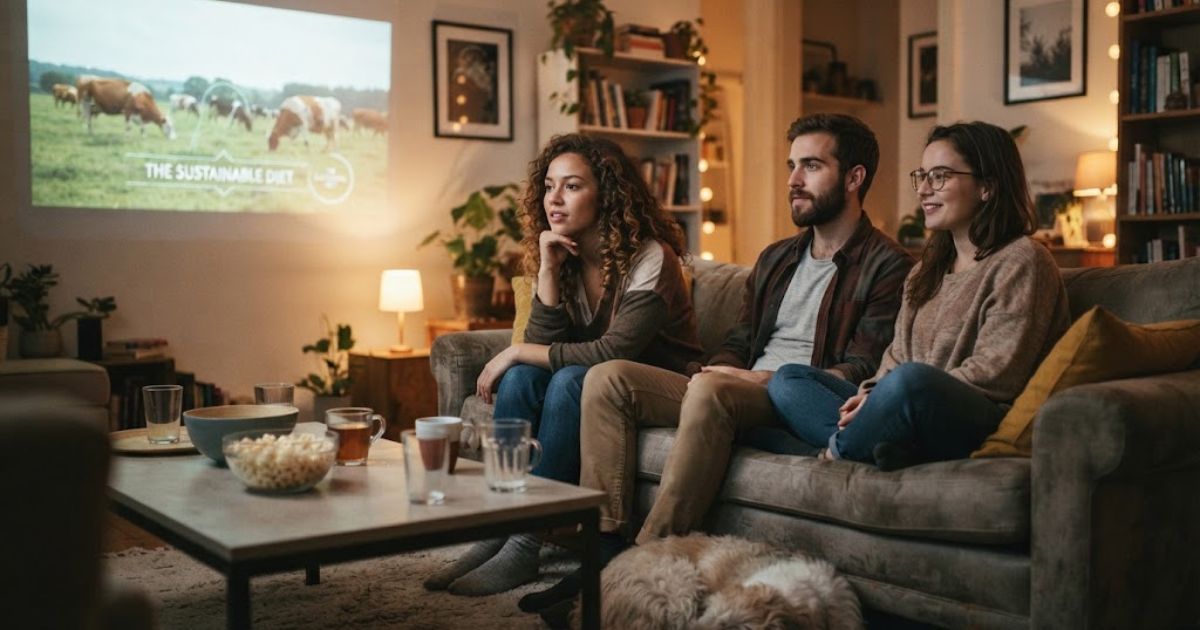
A graphic slaughterhouse scene changed more minds about meat than a thousand pamphlets ever could. That’s the power vegan movies hold, and it’s why this genre has grown from a niche activist tool into one of the most-watched documentary categories on Netflix, YouTube, and Amazon Prime.
Vegan movies are films, mostly documentaries, built around plant-based living, animal agriculture, or the ethics of eating animals. Some focus on health. Others expose factory farming. A few use artistic storytelling instead of narration to make their point.
This guide covers the most important vegan films available today, organized by what they’re actually trying to teach you. You’ll also learn which ones hold up scientifically, which ones to skip if you’re new to the topic, where to watch them, and the honest limitations of the genre that most roundup articles leave out.
What Counts as a “Vegan Movie”?
A vegan movie is any film whose central message supports plant-based eating, animal rights, or a critical look at animal agriculture. Most fall into one of three categories:
- Advocacy documentaries — built specifically to convince viewers to reduce or eliminate animal products (Cowspiracy, Dominion)
- Investigative documentaries — expose an industry practice without always pushing a vegan conclusion directly (Food, Inc., Seaspiracy)
- Artistic or narrative films — use storytelling, not narration or statistics, to generate empathy for animals (Gunda, Cow, Okja)
Not every film about food or animals is vegan in tone. A documentary can feature farming without advocating against it. Throughout this guide, I’ll be clear about which category each title falls into so you know what you’re getting before you press play.
Why Vegan Movies Have Grown So Popular
Streaming platforms changed how people encounter documentaries. A film that once required a festival ticket or a DVD order now sits one click away on Netflix or YouTube.
A few other reasons explain the surge:
- Health documentaries (Forks Over Knives, What the Health) tapped into growing interest in preventing chronic disease through diet
- Celebrity backing gave films mainstream visibility — James Cameron and Arnold Schwarzenegger produced The Game Changers; Joaquin Phoenix narrated Earthlings and Dominion
- Climate concern made environmental documentaries like Cowspiracy and Seaspiracy relevant to a much wider audience than just vegans
- Social media clips turned specific scenes into viral moments, driving people to watch the full film
None of this means every claim in these films is accurate. More on that later.
The Best Vegan Documentaries, Organized by Focus
Documentaries About Animal Welfare and Ethics
These films use direct footage from farms and slaughterhouses to argue against animal agriculture on ethical grounds. They are the most emotionally intense category.
Dominion (2018)
Directed by Chris Delforce and narrated by Joaquin Phoenix, Sia, and Sadie Sink, this Australian documentary uses drone and hidden-camera footage from farms, feedlots, and slaughterhouses across Australia, the US, and Canada. It’s available free on YouTube. It is graphic and not recommended for younger viewers.
Earthlings (2005)
Written and directed by Shaun Monson, narrated by Joaquin Phoenix with a score by Moby, this is often cited as the film that started the modern wave of vegan documentaries. It covers pet ownership, food, clothing, entertainment, and medical testing.
Land of Hope and Glory (2017)
Produced by UK animal rights group Surge, this documentary focuses specifically on British farming practices, challenging the idea that UK welfare standards are meaningfully different from factory farming elsewhere.
73 Cows (2018)
A short documentary (not a feature-length film) that won the BAFTA for Best British Short Film. It follows Jay Wilde, a Derbyshire farmer who converted his cattle farm into a vegan farm raising hemp instead. It’s a more hopeful, less graphic entry point than Dominion or Earthlings.
Documentaries About Health and Nutrition
These films argue for plant-based eating primarily on the basis of disease prevention and longevity.
Forks Over Knives (2011)
Directed by Lee Fulkerson, this film draws on the research of Dr. T. Colin Campbell (author of The China Study) and Dr. Caldwell Esselstyn, both of whom argue that whole-food, plant-based diets can prevent and sometimes reverse chronic disease.
What the Health (2017)
From Cowspiracy directors Kip Andersen and Keegan Kuhn, this film argues that animal product consumption is linked to chronic disease and claims health organizations downplay this link due to industry influence. It’s the most scientifically disputed film on this list — more detail in the section below.
PlantPure Nation (2015)
Directed by Nelson Campbell (T. Colin Campbell’s son), this film follows a community-level effort to introduce plant-based nutrition programs, offering a more grassroots, less confrontational tone than What the Health.
You Are What You Eat: A Twin Experiment (2024)
A Netflix docuseries built around an actual Stanford University study led by Dr. Christopher Gardner, following identical twins where one twin ate vegan and the other omnivorous for eight weeks. It’s one of the few vegan-adjacent productions grounded in a peer-reviewed clinical study rather than general advocacy.
Documentaries About Environmental Impact
Cowspiracy: The Sustainability Secret (2014)
Directed by Kip Andersen and Keegan Kuhn, with Leonardo DiCaprio joining as executive producer for its wider release, this film argues animal agriculture is the leading driver of environmental destruction. It popularized the claim that livestock cause 51% of global greenhouse gas emissions — a figure that has been widely disputed by climate scientists (see the accuracy section below).
Seaspiracy (2021)
A Netflix original directed by Ali Tabrizi, examining commercial fishing’s impact on ocean ecosystems, including bycatch, slavery in fishing fleets, and the limits of “sustainable seafood” labeling. Several scientists and organizations interviewed in the film publicly disputed how their comments were used, so it’s worth watching with some skepticism.
Eating Our Way to Extinction (2021)
Narrated by Kate Winslet, this film connects industrial animal agriculture to deforestation, biodiversity loss, and climate change, using footage from the Amazon, Indonesia, and elsewhere.
Documentaries That Expose the Food Industry
Food, Inc. (2008)
Directed by Robert Kenner, this Oscar-nominated documentary examines industrial food production broadly, including factory farming, but isn’t a vegan advocacy film in the strictest sense. It’s a strong entry point for understanding how the US food system works.
The Invisible Vegan (2019)
Directed by Jasmine Leyva, this film examines veganism through the lens of the African American community, looking at food access, historical diet patterns, and chronic disease disparities. It’s one of the few vegan documentaries centered on race and food justice.
Milked (2023)
A New Zealand documentary examining the country’s dairy industry, including the treatment of bobby calves and the environmental footprint of dairy farming in a country that exports dairy globally.
Artistic, Narration-Free Documentaries
These films skip statistics and advocacy entirely, relying on cinematography to build empathy.
Gunda (2020)
Directed by Victor Kossakovsky and executive produced by Joaquin Phoenix, this black-and-white film follows a mother pig and her piglets on a farm with zero narration, music, or text. It’s one of the most critically acclaimed films on this list, screened at major festivals rather than marketed as activist media.
Cow (2021)
Directed by British filmmaker Andrea Arnold, this documentary follows a dairy cow named Luma over several years on a British farm. Like Gunda, it has no narration — the footage itself carries the argument.
Vegan-Themed Fiction Films and Family Movies
Pure vegan advocacy fiction is rare, but several narrative films carry strong anti-factory-farming or animal-empathy messages.
| Film | Year | Type | Why It’s Relevant |
|---|---|---|---|
| Okja | 2017 | Fiction, Netflix | Bong Joon-ho’s story of a girl and a genetically engineered “superpig” doubles as sharp commentary on factory farming |
| Carnage: Swallowing the Past | 2017 | Mockumentary, BBC | Simon Amstell imagines a 2067 Britain where veganism is universal and meat-eating is viewed with shame |
| Babe | 1995 | Family fiction | Not vegan advocacy, but widely credited with making children question eating pigs |
| Chicken Run | 2000 | Animated family | Stop-motion story about chickens escaping a farm destined to become pies |
These aren’t substitutes for documentaries if you want facts and statistics. They work well as a gentler introduction, especially for families or viewers who find graphic footage overwhelming.
Quick-Reference Table: Best Vegan Movies at a Glance
| Title | Year | Focus | Intensity | Best For |
|---|---|---|---|---|
| Dominion | 2018 | Animal welfare | Very high | Viewers ready for graphic content |
| Earthlings | 2005 | Animal welfare | Very high | Understanding the genre’s origins |
| Cowspiracy | 2014 | Environment | Medium | Climate-motivated viewers |
| Seaspiracy | 2021 | Ocean/fishing | Medium | Seafood-eating viewers |
| What the Health | 2017 | Health | Medium | Health-motivated beginners (watch critically) |
| Forks Over Knives | 2011 | Health | Low | Science-curious beginners |
| The Game Changers | 2018 | Health/fitness | Low | Athletes, fitness-focused viewers |
| Gunda | 2020 | Animal empathy | Low-medium | Viewers who dislike narration-heavy docs |
| Cow | 2021 | Animal empathy | Low-medium | Dairy-specific perspective |
| You Are What You Eat | 2024 | Health (clinical) | Low | Viewers wanting science-based evidence |
| 73 Cows | 2018 | Animal welfare | Low | A hopeful, short entry point |
| Okja | 2017 | Fiction | Low | Teens, families, fiction lovers |
How to Choose the Right Vegan Movie for You
Pick based on what’s motivating your curiosity, not just popularity.
- Curious about health? Start with Forks Over Knives or You Are What You Eat before the more polarizing What the Health.
- Worried about climate change? Watch Cowspiracy first, then read independent fact-checks of its central statistics.
- Care most about animal ethics? Start with 73 Cows or Gunda before moving to Dominion or Earthlings if you want graphic footage.
- Eat a lot of seafood? Seaspiracy will challenge assumptions about “sustainable” fish labeling.
- Watching with kids or a skeptical partner? Choose Okja, Cow, or Gunda. Save Dominion and Earthlings for solo viewing.
- New to documentaries generally? Food, Inc. offers the broadest, least confrontational starting point.
Are Vegan Documentaries Scientifically Accurate? What to Know Before You Watch
Short answer: some claims hold up well; others have been significantly disputed. A trustworthy guide has to say this directly instead of treating every film as settled fact.
The 51% greenhouse gas claim (Cowspiracy)
Cowspiracy’s headline statistic — that animal agriculture causes 51% of global greenhouse gas emissions — comes from a 2009 Worldwatch Institute paper by Goodland and Anhang. Climate scientists have widely disputed this figure, arguing it used non-standard accounting methods. The Food and Agriculture Organization of the United Nations (FAO), in its 2013 report “Tackling Climate Change Through Livestock,” estimated livestock’s share at roughly 14.5% of global emissions — a figure far more widely cited in current climate research. Even that number is debated and varies by methodology, but 51% is considered an outlier.
What the Health’s health claims
Independent fact-checkers, including the Associated Press, criticized the film for overstating links between processed meat and conditions like diabetes, and for selectively citing studies while ignoring contradicting research. The film’s broader point — that diets high in processed and red meat carry health risks — is supported by organizations like the World Health Organization, but the specific framing in the film overstates certainty in several places.
Seaspiracy’s interview controversy
Multiple scientists and organizations featured in Seaspiracy, including representatives from the Marine Stewardship Council and individual researchers, said their comments were edited in ways that misrepresented their positions. The film’s broader warnings about bycatch and overfishing are grounded in real concerns, but specific claims and numbers in the film have been challenged by marine biologists.
This doesn’t mean these films are worthless. It means you should treat them the way you’d treat any advocacy content: valuable for raising questions, not a substitute for peer-reviewed research. If a statistic surprises you, search for it independently before repeating it.
Where to Watch Vegan Movies in 2026
Streaming availability changes frequently as licensing deals shift, so treat the following as general guidance rather than a guaranteed listing:
- Netflix has carried Seaspiracy, The Game Changers, Okja, and You Are What You Eat at various points
- YouTube hosts Dominion and Earthlings free, officially uploaded by their creators
- Amazon Prime Video often carries Cowspiracy, Forks Over Knives, and Food, Inc. for rent or with a subscription add-on
- Tubi and Plex offer free, ad-supported access to a rotating selection of documentaries, including some older titles
- Festival and distributor sites sometimes host films like Gunda or Cow directly, especially shortly after theatrical release
Before planning a watch list, check each platform’s current catalog. Titles move between services regularly, and a film available today may require a different platform next month.
Vegan Movies for Beginners vs. Experienced Vegans
| Stage | Good Starting Points | Why |
|---|---|---|
| Curious newcomer | Forks Over Knives, 73 Cows, Food, Inc. | Lower intensity, easier to process |
| Considering a diet change | You Are What You Eat, The Game Changers | Science-forward, less emotionally heavy |
| Ready for harder content | Dominion, Earthlings, Land of Hope and Glory | Graphic footage, strongest advocacy |
| Already vegan, want nuance | Cowspiracy + independent fact-checks, Seaspiracy + scientist responses | Builds critical thinking, not just reinforcement |
| Want artistic, reflective viewing | Gunda, Cow | No narration, slower pace, strong emotional impact without statistics |
Experienced vegans sometimes skip straight to the most graphic films, assuming newcomers should too. That approach often backfires — people shut down emotionally rather than engage. Sequencing matters.
Vegan Movies for Kids and Families
Most vegan documentaries are not appropriate for children due to graphic slaughterhouse footage. For families wanting to introduce the topic gently:
- Babe and Chicken Run raise empathy for farm animals without any explicit advocacy
- Okja works well for older children and teens, though it does include some intense scenes
- Gunda and Cow can work for older kids who can handle a slower, documentary pace, since neither contains graphic violence — both rely on quiet observation
Avoid Dominion, Earthlings, and Land of Hope and Glory for children. These are made for adult audiences and contain disturbing footage by design.
Common Mistakes People Make When Watching Vegan Movies
- Starting with the most graphic film first. Jumping straight to Dominion or Earthlings often overwhelms rather than persuades. Build up from gentler films if you’re new to the topic.
- Treating every statistic as settled fact. Films like Cowspiardspiracy and What the Health present disputed numbers as certainties. Cross-check surprising claims before repeating them.
- Assuming all vegan movies agree with each other. Health-focused films and environment-focused films sometimes use different, even contradictory, statistics because they’re drawing from different studies.
- Ignoring the filmmaker’s perspective. Several high-profile vegan documentaries share the same production team (Andersen and Kuhn made Cowspiracy, What the Health, and produced Seaspiracy). Watching multiple films from the same team isn’t the same as getting multiple independent perspectives.
- Watching alone when discussion would help. These films often raise emotionally charged claims. Watching with someone else, or following up with a discussion or a registered dietitian for health-specific questions, leads to better-informed decisions than watching in isolation.
Expert Tips for Getting the Most Out of Vegan Documentaries
- Pair a health-focused film like Forks Over Knives with a conversation with a registered dietitian before making major dietary changes, especially if you have existing health conditions
- Read at least one independent fact-check or scientific response for any documentary that makes a specific numerical claim (emissions percentages, disease risk statistics, water usage figures)
- Watch one advocacy film and one neutral investigative film (Food, Inc. is a good neutral option) to see how framing changes the message
- If a film affects you emotionally, give yourself time before making permanent decisions like fully eliminating food groups — gradual change tends to stick better than reactive change
- Use these films as a starting point for research, not the final word, especially on health and environmental statistics
Frequently Asked Questions
What is the best vegan movie to start with?
Forks Over Knives or Food, Inc. work well for most beginners because they present information without the most graphic slaughterhouse footage. If animal ethics is your main interest, 73 Cows is a gentler starting point than Dominion or Earthlings.
Is Cowspiracy’s 51% emissions claim accurate?
No, it’s widely disputed. The figure comes from a 2009 Worldwatch Institute paper using non-standard accounting methods. The FAO’s more widely cited 2013 estimate puts livestock’s share of global greenhouse gas emissions at around 14.5%, though estimates vary by methodology and continue to be studied.
Are vegan documentaries biased?
Yes, most are intentionally advocacy-driven, which isn’t inherently dishonest but does mean they select evidence to support a conclusion. Films like Gunda and Cow are exceptions, since they present footage without narration or argument, letting viewers draw their own conclusions.
Can watching one vegan movie actually change someone’s diet?
Documentaries can be a strong motivator, and many people point to a specific film as the trigger for changing their diet. Lasting change usually depends on more than one film, though — ongoing information, support, and practical meal planning tend to matter as much as the initial motivation.
Are there vegan movies suitable for children?
Most documentary-style vegan films are not appropriate for young children due to graphic content. Babe, Chicken Run, and Okja (for older kids and teens) carry animal-empathy themes without explicit slaughterhouse footage.
Where can I watch vegan documentaries for free?
Dominion and Earthlings are both officially available free on YouTube. Platforms like Tubi and Plex also offer free, ad-supported access to a rotating selection of documentaries, though specific titles change over time.
What’s the difference between a vegan movie and a vegetarian movie?
There isn’t a widely used separate “vegetarian movie” category. Most films in this space advocate for eliminating all animal products, including dairy and eggs, not just meat, which aligns with vegan rather than vegetarian positions.
Is Seaspiracy trustworthy?
Parts of it are well-supported, particularly its warnings about bycatch and the limitations of sustainable seafood certification. However, several scientists interviewed in the film publicly said their comments were used out of context, so specific claims deserve independent verification rather than full acceptance.
Conclusion
Vegan movies range from clinically grounded documentaries like You Are What You Eat to emotionally raw films like Dominion to quiet, narration-free portraits like Gunda. None of them tell the complete story on their own, and the strongest viewers treat them as a starting point for further research rather than a final verdict.
If you’re new to this topic, start gentle, verify the big numbers before repeating them, and match the film to what you’re actually curious about, whether that’s your health, the planet, or the animals themselves. The right vegan movie for you depends less on what’s trending and more on what question you’re trying to answer.